
What Is Odoo CRM? Features, Benefits & Use Cases
What Is Odoo CRM? Features, Benefits & Use Cases
 Bhargav A
Managing customer relationships is essential for businesses that want to generate more leads, improve sales processes, and build long-term customer loyalty. However, when customer information is scattered across spreadsheets, emails, and different applications, sales teams can struggle to track conversations, manage follow-ups, and identify promising opportunities.This is where Odoo CRM can help.
What Is Odoo CRM?
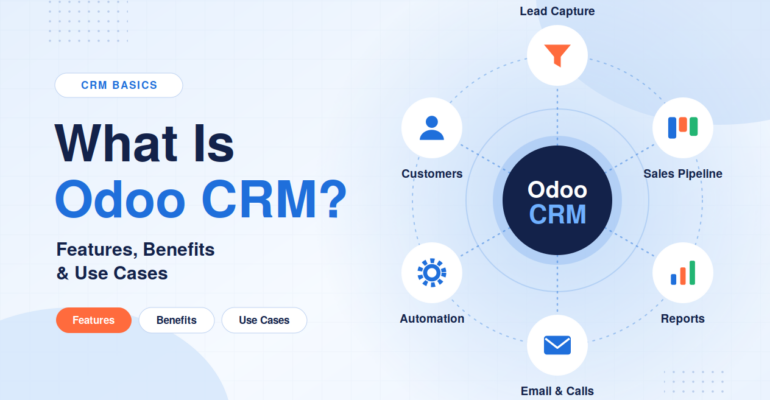
Odoo CRM is the customer relationship management application inside the Odoo ERP suite. It helps businesses capture leads, manage opportunities, track customer interactions and forecast revenue from one visual workspace.
The biggest difference from standalone CRM tools is that Odoo CRM is natively connected to the rest of your business. A lead can become a quotation, then a sales order, an invoice, a delivery and a support ticket, all without exporting data or buying separate connectors.
Odoo CRM is modular, so you can start with only CRM and later add Sales, Accounting, Inventory, HR, Website and more as your business grows.
Key Features of Odoo CRM
Odoo CRM offers several features that help businesses manage leads, track sales opportunities, automate follow-ups, and monitor sales performance. These tools help sales teams organize their workflows, improve customer communication, and manage the sales process more efficiently.
1. Lead Management
Odoo CRM helps businesses capture, organize, and track potential customers from different sources, including website forms, emails, manual entry, and supported integrations. Sales teams can qualify leads, assign responsibilities, and convert promising prospects into opportunities.
2. Visual Sales Pipeline
The Kanban pipeline provides a clear overview of opportunities at different sales stages, such as New, Qualified, Proposal, Won, or Lost. Sales representatives can update opportunity stages as deals progress, while managers can identify delayed deals and prioritize follow-ups.
3. Follow-Up Activities and Reminders
Sales teams can schedule calls, meetings, emails, and other activities directly against leads and opportunities. Reminders and activity tracking help representatives stay organized and reduce the chances of missing important follow-ups.
4. Predictive Lead Scoring
Odoo CRM can use predictive lead scoring to help identify promising prospects based on available historical data and relevant lead attributes. This helps sales teams prioritize their efforts, although scoring accuracy depends on data quality and system configuration.
5. Email and Website Integration
Odoo CRM can connect with website forms and email workflows to help businesses capture enquiries and maintain relevant communication records. These integrations reduce manual data entry and make customer information easier for sales teams to access.
Businesses can explore Odoo Website Integration services from Banas Tech to learn more about connecting website enquiries with Odoo workflows.
6. Sales Reporting and Forecasting
Odoo CRM provides reports that help businesses analyze pipeline performance, track opportunities, review conversion trends, and estimate potential revenue. These insights support better sales planning and help managers identify areas that need improvement.
7. Quotation and Sales Integration
Odoo CRM integrates with Odoo Sales, allowing sales representatives to create quotations from opportunities. Depending on the installed applications and configuration, the process can continue into sales orders, invoicing, and inventory management.
8. Automation and Customization
Businesses can configure assignment rules, automated actions, custom fields, and workflows to match their sales processes. For advanced requirements, an experienced Odoo development company can help implement custom features and integrations.
Benefits of Using Odoo CRM
Odoo CRM helps businesses streamline sales operations, improve customer relationships, and manage leads more effectively. Its integration capabilities and flexible workflows make it suitable for businesses looking to improve productivity and support growth.
1. Centralized Business Management
Odoo CRM can connect with applications such as Sales, Accounting, and Inventory, allowing businesses to manage related information within an integrated system. This reduces duplicate data entry and helps teams maintain consistent customer and sales records.
2. Improved Lead Conversion
Lead tracking, scheduled activities, reminders, and predictive lead scoring help sales teams prioritize prospects and follow up on time. A structured sales process can reduce missed opportunities and improve the chances of converting qualified leads into customers.
3. Cost-Effective and Scalable Solution
Odoo’s modular approach allows businesses to start with the applications they need and expand as their requirements grow. This flexibility makes it suitable for small businesses as well as larger organizations with more complex sales processes. Overall costs depend on the selected plan, applications, implementation, and customization requirements.
4. Better Customer Visibility
By maintaining customer details, opportunity records, activities, and relevant communication history in one place, Odoo CRM gives sales teams a clearer view of customer interactions. When connected applications are configured appropriately, teams can also access related quotations, orders, and invoices to support better customer service.
5. Data-Driven Sales Decisions
Sales reports and pipeline analysis help managers monitor opportunity progress, evaluate team performance, and identify bottlenecks. These insights support more informed planning and revenue forecasting based on the quality of available sales data.
6. Flexible Customization and Automation
Odoo CRM can be configured to match different sales processes through custom fields, assignment rules, automated actions, and integrations. For businesses with specialized requirements, an experienced Odoo development company can help implement tailored workflows and extend the platform’s functionality.
Odoo CRM Business Use Cases
Odoo CRM can support businesses across different industries by organizing customer enquiries, managing sales opportunities, and improving follow-up processes. Its integration with other Odoo applications also helps businesses connect CRM activities with their broader operations.
1. Real Estate and Construction
Real estate companies can use Odoo CRM to manage property enquiries, schedule site visits, track negotiations, and follow up with prospective buyers. Construction businesses can also organize client enquiries and sales opportunities while connecting relevant processes with other business applications.
Explore Banas Tech’s Real Estate Solutions and Construction ERP to learn more about industry-specific workflows.
2. Finance and Lending
Financial service providers can use CRM workflows to track prospective customers, manage enquiries, schedule follow-ups, and coordinate customer communication. When integrated with a suitable loan management system, CRM can support the customer acquisition process alongside application and loan processing workflows.
Discover Banas Tech’s Finance Solutions and Loan Management System.
3. Healthcare
Healthcare organizations can use CRM to manage service enquiries, appointment-related follow-ups, and patient communication workflows. Access to sensitive information should be controlled according to applicable privacy requirements and the organization’s system configuration.
4. Retail and eCommerce
Retailers can connect CRM with Sales, Inventory, and Website applications to manage customer enquiries, maintain customer records, and coordinate sales activities. Depending on the setup, businesses can also use customer information to support marketing campaigns and encourage repeat purchases.
5. Education
Educational institutions can use Odoo CRM to track admission enquiries, organize counseling sessions, schedule follow-ups, and monitor prospective students throughout the enrollment process. This helps admission teams maintain consistent communication and identify enquiries that need attention.
6. Service-Based and B2B Businesses
IT companies, consulting firms, marketing agencies, and other B2B organizations can use Odoo CRM to manage long sales cycles, track client discussions, prepare quotations, and coordinate follow-ups. Once an opportunity is won, integration with relevant Odoo applications can help connect the sales process with project delivery, invoicing, and ongoing customer management.
Planning a Successful CRM Implementation
Successful Odoo CRM implementation involves more than installing software. The system must reflect the organization’s sales process and provide a practical experience for the people using it.
A structured implementation process generally includes the following steps.
1. Define business requirements
Identify how leads enter the business, how salespeople qualify opportunities, which stages deals pass through, and what managers need to measure.
2. Configure the CRM workflow
Set up sales teams, pipeline stages, activities, access permissions, and other relevant settings.
3. Prepare and migrate data
Review existing customer records and determine how contacts, leads, and opportunities should be transferred. Clean and validate data before migration to reduce duplication and inconsistencies.
4. Configure integrations and customizations
Connect the website, email systems, or other business applications where required. Develop custom functionality only when the requirements justify it.
5. Test real business scenarios
Test lead creation, assignment, follow-up activities, reporting, permissions, and integrations before the system goes live.
6. Train users and provide ongoing support
Help sales teams understand the new process and establish consistent data-entry practices. Review the implementation after launch and improve workflows when needed.
Banas Tech offers Odoo implementation services to help businesses plan and configure Odoo solutions around their operational requirements.
Why Choose Banas Tech for Odoo CRM Services?
Choosing a CRM solution is only one part of the process. Businesses may also need technical guidance, workflow configuration, integration, customization, migration, and ongoing support.
Banas Tech provides Odoo-focused development and implementation services, including customization, integration, and support for business-specific workflows. Its published company profile describes experience serving industries such as real estate, healthcare, finance, education, and non-profit organizations.
Working with an experienced implementation team can help businesses assess their requirements, identify suitable standard features, and determine where additional development may be necessary.
Depending on your project, Banas Tech can help you explore:
- Odoo CRM setup and implementation
- Custom CRM fields, workflows, and modules
- Website and third-party application integration
- Data migration and version upgrades
- Ongoing technical support and maintenance
If your business needs to connect CRM processes with other operational systems, explore Banas Tech’s Odoo CRM Integration services.
The right solution should be based on your current processes, future requirements, budget, and technical environment rather than a one-size-fits-all configuration.
Conclusion
Odoo CRM gives businesses a structured way to manage leads, track opportunities, coordinate follow-ups, and understand their sales pipeline. Its value comes from matching the system to the organization’s actual sales process and ensuring that employees use it consistently.
For businesses with specialized workflows, additional Odoo customization and integration can help connect CRM activities with existing applications and operational processes.
Whether you are introducing CRM for the first time or improving an existing Odoo environment, a clear implementation plan can help you choose the right features and avoid unnecessary complexity.
Looking to implement or customize Odoo CRM for your business?
Banas Tech can help you explore an Odoo solution aligned with your business requirements, from CRM implementation and customization to integrations and ongoing technical support.
Contact Banas Tech to discuss your Odoo CRM requirements and identify the right next steps for your business.