
Odoo HR & Payroll: Features, Benefits, and Implementation Guide
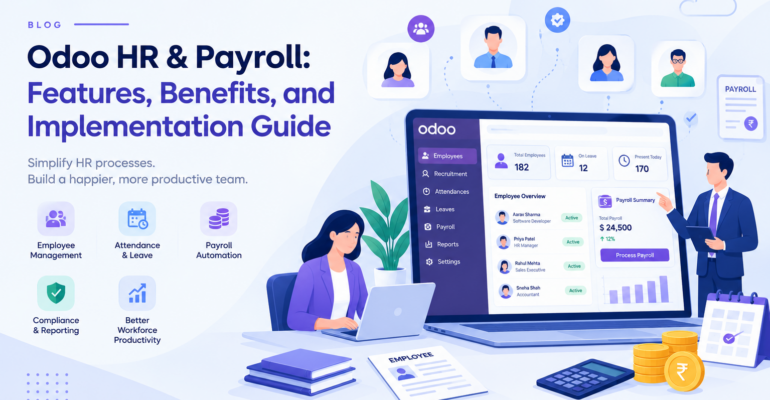
Odoo HR & Payroll: Features, Benefits, and Implementation Guide
 Bhargav A
Odoo HR & Payroll helps businesses manage employee records, recruitment, attendance, leaves, expenses, and salary processing from a single integrated system. It brings core HR activities together so that HR teams spend less time on repetitive administration and more time on people management.
When businesses rely on spreadsheets, paper forms, or disconnected tools to manage employee data, attendance, leave balances, and salary calculations, errors and delays are common. Odoo connects these processes so that employee information flows from hiring to payroll without repeated data entry.
In this guide, we explore the key features of Odoo HR & Payroll, its benefits, its integration with other Odoo modules, and the steps involved in implementing it for your business.
What Is Odoo HR & Payroll?
Odoo HR is a set of applications that cover the employee lifecycle, from recruitment and onboarding to attendance, leave management, expenses, and payroll. Odoo Payroll builds on the employee and attendance data to calculate salaries, generate payslips, and prepare payroll-related accounting entries.
Instead of using separate tools for each HR function, businesses can manage everything within the same ERP, with a single employee record at the center.
Key capabilities include:
- Centralized employee database and organization chart
- Recruitment and applicant tracking
- Attendance tracking
- Time off and leave management
- Expense management
- Timesheets for project and service teams
- Salary structures, payslips, and payroll rules
- Integration with Odoo Accounting, Projects, and other applications
Why Do Businesses Need an Integrated HR and Payroll System?
HR processes touch every employee in the company. When they are handled manually, small errors can become costly.
1. Scattered Employee Records
Employee contracts, personal details, documents, and job information are often stored across folders, spreadsheets, and email threads. A central employee database keeps this information organized and accessible to authorized users.
2. Manual Attendance and Leave Tracking
Tracking attendance and leave balances manually makes it hard to know who is available and how many leaves each employee has used. Odoo records attendance and leave requests in the system, with approval workflows for managers.
3. Payroll Calculation Errors
Calculating salaries manually, with allowances, deductions, and attendance adjustments, is time-consuming and error-prone. Payroll rules configured in Odoo help apply the same calculation logic every month.
4. Slow Recruitment Processes
Without a structured process, candidate information gets lost and hiring takes longer. A recruitment pipeline helps HR teams track applicants at each stage.
5. Disconnected HR and Finance Data
When HR and finance work in separate systems, payroll figures need to be re-entered into accounting. Integration reduces duplicate entry and improves consistency between HR and financial records.
Key Features of Odoo HR & Payroll
1. Employee Management
Odoo stores employee profiles, job positions, departments, contracts, work schedules, and documents in one place. Managers and HR staff can view the organization chart and understand reporting lines.
Access rights can be configured so that sensitive information, such as salary details, is visible only to authorized users.
2. Recruitment
Odoo Recruitment helps HR teams manage job positions, publish openings on the website, and track applicants through a pipeline.
Capabilities include:
- Job position management and website job listings
- Applicant pipeline with configurable stages
- Interview scheduling and tracking
- Candidate communication through the system
- Conversion of hired applicants into employee records
Converting an applicant into an employee reduces repeated data entry and helps start onboarding faster.
3. Attendance Tracking
Odoo Attendances lets employees check in and check out, and helps HR teams monitor working hours.
Depending on your setup, attendance can be recorded through the Odoo interface, a kiosk mode, or compatible devices. This data can then be used for overtime tracking and payroll calculations.
4. Time Off and Leave Management
Odoo Time Off manages leave types, leave allocations, requests, and approvals.
Employees can request leave online, managers can approve or refuse requests, and HR can view leave balances. Public holidays and company-specific leave policies can be configured, and approved leaves appear in a shared calendar so teams can plan around absences.
5. Expense Management
Employees can record business expenses, attach receipts, and submit them for approval. Approved expenses can then be reimbursed and recorded in accounting.
This gives finance teams a clearer view of employee spending and simplifies reimbursement.
6. Timesheets
For service companies and project-based teams, Odoo Timesheets tracks time spent on projects and tasks. This data can support project costing and, when connected with Sales, customer billing based on time.
7. Payroll Processing and Payslips
Odoo Payroll uses salary structures and rules to calculate employee compensation, including basic salary, allowances, deductions, and other components.
Capabilities include:
- Configurable salary structures and rules
- Payslip generation for individual employees or batches
- Use of attendance and leave data in salary calculations
- Payroll-related accounting entries
- Payslip delivery and payroll reports
Because payroll uses the same employee, attendance, and leave records, there is less need to compile data from separate sources before each payroll run.
8. Payroll for Indian Businesses
Indian businesses have specific payroll requirements. The Indian localization covers payroll structures that may include components such as provident fund (PF), employee state insurance (ESI), and professional tax, depending on your Odoo version and configuration.
The exact statutory rules depend on your company size, location, and employee categories. Verify the localization for your Odoo version and review the configuration with a qualified payroll or compliance professional before go-live.
9. Appraisals and Skills
Odoo Appraisals helps managers conduct periodic employee reviews, while skills and resume information on employee profiles help HR teams understand the capabilities available in the company. These features help organizations maintain a more structured performance review process.
How Odoo HR & Payroll Integrates with Other Odoo Modules
One of the main advantages of Odoo is that HR data connects with other business functions.
Odoo HR + Accounting
Payroll and expense data can generate accounting entries, which reduces duplicate entry between HR and finance and helps maintain consistent financial records. Finance teams can review salary expenses and employee reimbursements within the accounting application.
Odoo HR + Projects and Timesheets
Employee timesheets can feed project tracking and costing, giving managers visibility into how time is spent across projects and customers.
Odoo HR + Manufacturing
Manufacturing businesses can use attendance and employee data to understand shift schedules and labor allocation alongside production operations. To see how production planning works in Odoo, read our guide on Odoo MRP.
Odoo HR + Sales and CRM
Sales and service teams can use employee records and timesheets alongside customer-facing workflows. Businesses that use Odoo CRM can keep sales team members, targets, and activities connected to the same employee database.
Practical Example: Odoo HR & Payroll for a Growing Company
Consider a company with 80 employees across a head office and a production unit. HR currently tracks attendance in spreadsheets, leave requests arrive by email, and payroll is calculated manually at the end of each month.
This creates delays in payroll, disputes over leave balances, and extra work for the finance team.
With a properly configured Odoo workflow:
- HR records a new hire from the recruitment pipeline and creates the employee record.
- The employee’s contract, department, and salary structure are configured.
- Employees record attendance, and leave requests are approved in the system.
- Expenses are submitted with receipts and approved by managers.
- At month-end, HR generates payslips using attendance, leave, and salary rules.
- Payroll entries flow to accounting for review.
- Managers review reports on headcount, absences, and payroll costs.
The exact workflow depends on the company’s policies, payroll rules, and the applications installed.
Benefits of Implementing Odoo HR & Payroll
When configured according to business requirements, Odoo HR & Payroll can offer several benefits.
Centralized employee data: HR teams work from a single, organized employee record.
Less manual work: Connected workflows reduce repeated data entry across attendance, leave, and payroll.
More consistent payroll: Configured salary rules apply the same logic every payroll cycle.
Better leave and attendance visibility: Managers and HR can see availability and leave balances in real time.
Faster hiring: A structured recruitment pipeline helps teams track candidates and move them to onboarding.
Stronger HR and finance alignment: Integration with accounting keeps payroll and expense records consistent.
Actual results depend on data quality, configuration, employee training, and the suitability of the configured workflows.
How to Implement Odoo HR & Payroll
A successful HR and payroll implementation requires accurate employee data, clearly defined policies, and careful testing before the first live payroll.
Step 1: Analyze Your HR and Payroll Requirements
Document your current processes for hiring, attendance, leave, expenses, and payroll. Identify the number of employees, locations, pay structures, and reporting needs.
Step 2: Configure Company and Employee Structure
Set up departments, job positions, work schedules, and employee categories. Define who can access which HR information.
Step 3: Define Leave, Attendance, and Expense Policies
Configure leave types, allocations, approval flows, attendance rules, and expense categories according to company policy.
Step 4: Configure Salary Structures and Payroll Rules
Set up salary components, allowances, deductions, and payroll rules. For Indian businesses, review PF, ESI, professional tax, and other applicable requirements with a qualified professional.
Step 5: Migrate Employee Data
Prepare and validate employee records, contracts, opening leave balances, and relevant payroll history. Verify the data before moving into production.
Step 6: Integrate Related Applications
Connect HR with Accounting, Projects, Timesheets, or other applications where required, and test how data flows between them.
Step 7: Test with a Parallel Payroll Run
Run payroll in Odoo alongside your existing process for at least one cycle. Compare payslips, deductions, and accounting entries before switching over.
Step 8: Train Users and Go Live
Train HR staff, managers, and employees on the workflows they will use. Establish procedures for approvals, payroll closing, and data access.
Step 9: Provide Ongoing Support
Review feedback, update payroll rules when policies or regulations change, and improve workflows as the business grows.
A structured implementation helps reduce disruption and makes it easier for employees and HR teams to adopt the system.
Why Choose BanasTech for Odoo Implementation?
An HR and payroll system must reflect your company’s policies and local requirements, so the right implementation partner matters.
BanasTech offers Odoo implementation-related services, including system setup, data migration, testing, user training, and ongoing support. Businesses evaluating Odoo HR & Payroll can discuss their existing processes, payroll structure, and integration needs before selecting an approach.
An implementation project may include:
- Reviewing your current HR and payroll processes
- Configuring the required Odoo HR applications
- Setting up salary structures and payroll rules
- Planning employee data migration
- Connecting HR with accounting and other modules
- Testing workflows, including a parallel payroll run
- Supporting user training and system rollout
- Providing ongoing support according to the agreed scope
If your company has payroll rules or approval workflows that go beyond standard features and learn more about the process, explore the Odoo Services offered by BanasTech.
Is Odoo HR & Payroll Right for Your Business?
Odoo HR & Payroll may be suitable for businesses that want to organize employee data, simplify leave and attendance tracking, and connect payroll with their wider business operations.
It is particularly relevant for:
- Small and medium-sized businesses outgrowing spreadsheets
- Manufacturing companies managing shift-based teams
- Service companies that track employee time on projects
- Companies with multiple departments or locations
- Organizations that want HR and finance data in one system
Before choosing a solution, evaluate your headcount, payroll complexity, statutory requirements, integration needs, and implementation budget.
Conclusion
Odoo HR & Payroll helps businesses manage employee records, recruitment, attendance, leave, expenses, and payroll within an integrated ERP environment.
By connecting HR with accounting, projects, and other business applications, companies can reduce manual work and keep people data consistent across departments.
Successful implementation requires accurate employee data, well-defined policies, proper payroll configuration, and user training.
If your business is looking to improve its HR and payroll processes with Odoo, BanasTech can help you explore implementation options based on your requirements.
Ready to simplify your HR and payroll operations?
Contact BanasTech or explore our Odoo Implementation Services to discuss your requirements and take the next step toward a more connected business management system.